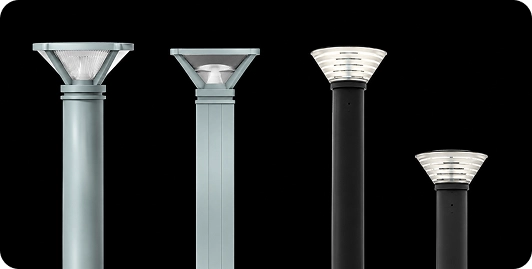
Why this collection?
Each unit is fully self-powered: a solar panel charges an integrated battery during the day, and the LED runs off that stored charge at night.
No wiring required — fully self-powered installation
Monocrystalline solar panels, Grade A cells, 19.4%+ efficiency
LiFePO4 battery — a 10+ year rated lifespan
Runs up to 4 consecutive rainy days on stored charge alone
Philips LED chips at 196+ lumens per watt
5-year warranty standard
Built for sites without line power
A bollard collection built for sites without easy access to line power — pathways, campuses, parks, and perimeters where running conduit is expensive or impossible. Every unit pairs a solar panel, battery, LED module, and controller into one self-contained fixture.
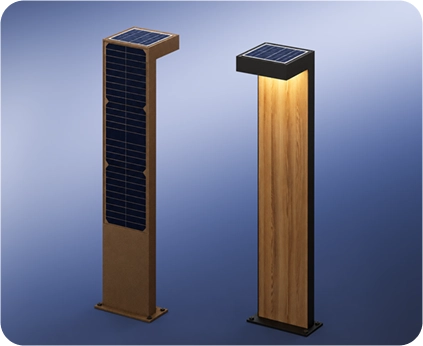
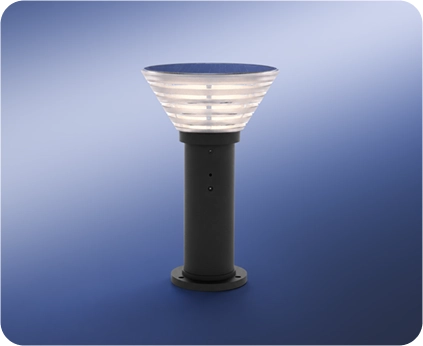
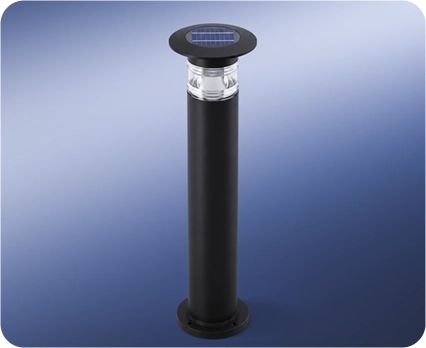
Standard bollards
The core range, covering general pathway and landscape lighting.
Pathways & landscapeVandal-resistant bollards
Reinforced housings for high-traffic or public-access sites, rated to IK10+.
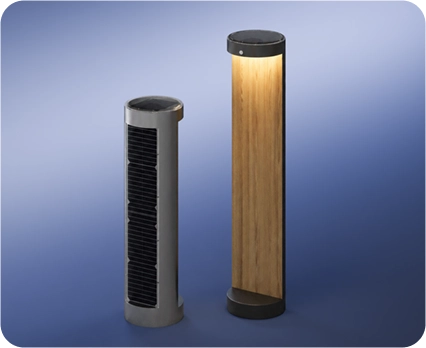
Public & high-trafficSolar columns
Taller profiles for a more architectural presence where bollard height isn't the right scale.
Architectural scale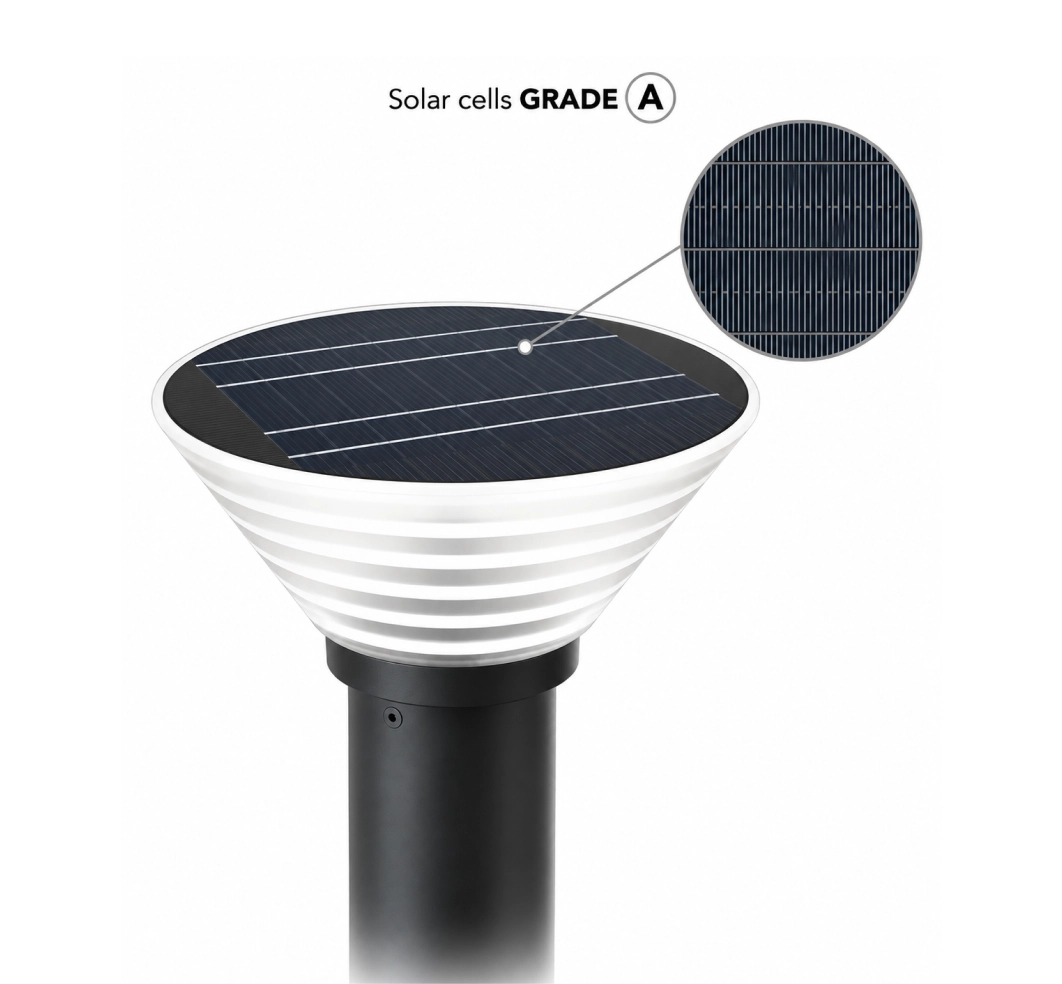
- Grade A monocrystalline cells, rated above 19.4% efficiency
- Sized per fixture to match its battery and LED load
- Higher efficiency keeps output consistent through shorter, lower-light days
- LiFePO4 lithium chemistry — more stable and longer-lived than Lithium-Ion or NiMH
- Rated for 10+ years of service life
- Proven across 400,000+ units installed worldwide
- Sized to run up to 4 consecutive rainy days on stored charge alone
- Symmetrical optics — even coverage, suited to open areas
- Asymmetrical optics — directed output, suited to pathways and perimeters
- Optic matched to mounting height and spacing; confirm beam data per model's IES file
- Sensor type varies by model — not uniform across the collection
- Vandal-resistant models (e.g. VANDAL) use microwave detection, 270° coverage
- Other models (e.g. ROR 110) use PIR (infrared) detection instead
- Confirm sensor type per spec sheet before specifying
- Quick & Easy Installation — Simply install the bollard in the ground or on a concrete base and switch it on.
- No Cabling or Trenching — No electrical wiring or underground trenching required.
- LED modules — 80,000+ hours
- Battery — 10+ years
- Aluminum housing + AKZO NOBEL powder coating — resists UV, heat, and humidity over the same timeframe
Lighting Without Limits
Versatile lighting solutions designed for every space and purpose.
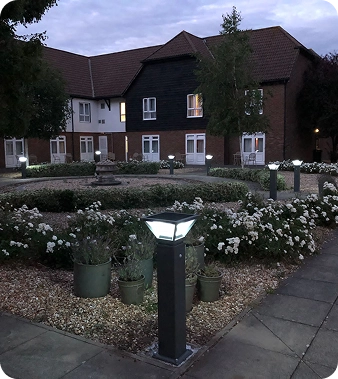
Parks & garden pathways
Where running power would mean disturbing landscaping.
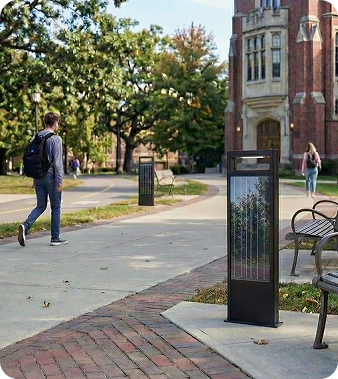
Campus & institutional grounds
Especially phased or remote sections of a larger site.
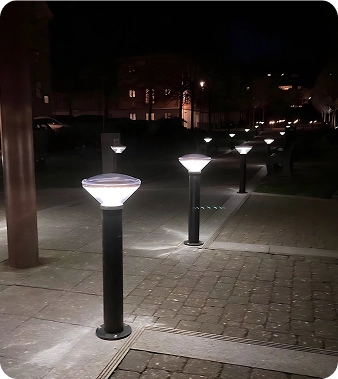
Parking lots & perimeters
Where standalone lighting avoids costly trenching.
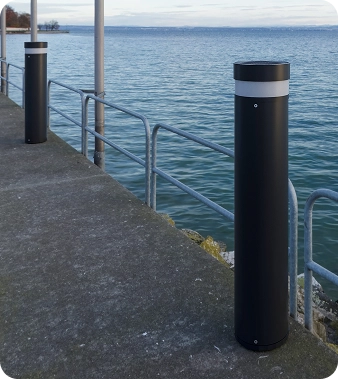
Coastal & remote sites
Where grid access is limited or corrosion resistance matters most.
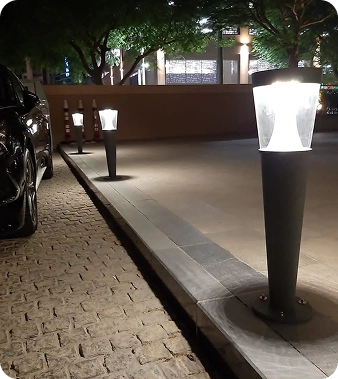
Retrofit projects
Adding lighting to an existing site without new electrical infrastructure.
Every fixture is tested before it ships
Not sampled, not spot-checked. Materials are inspected on arrival, checked at each production stage, and every completed unit is verified before shipping.
- 01
Incoming inspection — materials checked before production
- 02
In-process inspection — checked at each stage
- 03
Final inspection — every unit checked before shipping
5-year warranty
Standard across the collection.

IP rating test
Dust and water sealing.

Thermal shock test
Seals hold under temperature swings.

Environmental stress test
Long-term outdoor exposure simulation.

Materials & product test
Strength and finish durability.

Electrical safety test
Wiring meets safety standards.
Specification Support You Can Rely On
Our experienced team is available to assist with product selection, technical specifications, lighting layouts, and project requirements — whether you're developing a new specification or evaluating solutions for an upcoming project.
Frequently asked questions
Solar bollards, answered
No. Each unit is fully self-powered — a solar panel charges an integrated battery during the day, and the LED runs off that stored charge at night. There's no wiring, trenching, or conduit run required, which is the main reason this collection gets specified on sites where grid access is limited or expensive to extend.
Fixtures are designed to run for up to 4 consecutive days of rain or heavy cloud cover on stored battery charge alone, without needing a recharge. Exact autonomy varies by model and is detailed on the individual spec sheet — projects in consistently low-sun climates should confirm autonomy figures before specifying.
LiFePO4 batteries are more thermally stable and have a longer service life than standard Lithium-Ion or NiMH batteries, which is why Bullard Solar has standardized on the chemistry across the collection. The tradeoff of other battery types is typically lower upfront cost, at the expense of a shorter usable lifespan.
No — sensor type varies by model. Vandal-resistant models like VANDAL use microwave detection with 270° coverage, based on the same Doppler-effect principle used in radar, which makes it unaffected by ambient light, color, or temperature shifts. Other models, like ROR 110, use a PIR (infrared) sensor instead, which detects heat rather than motion directly. Confirm the sensor type on the individual product's spec sheet — don't assume one sensor technology applies across the whole collection.
Yes, on models equipped with the relevant hardware. A wireless diagnosis system allows real-time checks of battery state, solar charging history, product age, and temperature. For multi-fixture sites, Bullard Solar Bridge uses LoRa or Zigbee to monitor and control a batch of fixtures remotely, including programming, fault alerts, and location tracking.
Yes. The aluminum housing paired with AKZO NOBEL powder coating is specifically formulated to resist salt corrosion from seaside locations, in addition to UV discoloration and heat/humidity exposure. Confirm the specific finish and rating for a given model before specifying for a high-corrosion site.
Standard bollards cover general pathways and landscape lighting. Vandal-resistant models (like VISION and DOMIO) use reinforced housings built for high-traffic public sites where the fixture may see physical contact or attempted tampering. Solar columns (like SOLIS COLUMN) offer a taller, more architectural profile for sites where a bollard's typical height isn't the right scale.
Still have questions? Our support team is here to help. Contact Support